Spiral notebooks are among the most widely used stationery products in schools, offices, and retail markets around the world. They range from simple school notebooks to premium business organizers. Different types of spiral notebooks are designed to meet various needs, including writing, planning, and branding.
For wholesalers, it is important to understand the different types of spiral notebooks. This helps in choosing the right products for specific industries and customer groups. This guide covers the main types of spiral notebooks, their applications, inner page format options, and current market trends.

What Is a Spiral Notebook?
The global spiral notebook market size reached USD 6.7 billion in 2024. It is growing at a CAGR of 4.2% and is expected to reach USD 9.5 billion by 2033.
A spiral notebook uses a continuous coil, usually made of metal wire or plastic, to bind pages together. The pages are punched with evenly spaced holes along the edge, and the coil is threaded through these holes to hold them in place. This structure allows the notebook to open fully flat or fold back.
The spacing between holes is standardized and must match the coil pitch to ensure smooth rotation and stable binding. In most common specifications, the hole pitch is measured as holes per inch (HPI), typically around 3:1 or 2:1.
For example, a 3:1 pitch means three holes per inch of binding edge, while a 2:1 pitch means two larger holes per inch. A higher hole density (3:1) is usually used for thinner coils and lighter notebooks, while a lower density (2:1) is used for thicker, more durable notebooks and planners.
Advantages of Spiral Notebooks
- Lay-flat Design
Pages can lie completely flat, improving writing comfort. - 360-degree Fold-back Capability
The notebook can be folded in half, making it ideal for use in limited spaces. - Easy Page Turning
The coil structure allows smooth flipping without damaging the spine. - Durability in Daily Use
Less prone to spine damage compared to glued or stitched notebooks. - Easy to Tear Out
The perforated design allows you to tear out individual pages neatly without damaging the structure of the notebook.

Main Types of Spiral Notebooks
Spiral notebooks come in several types. Each types of spiral notebooks is designed with a different binding structure, material, and use purpose. Understanding these types of spiral notebooks help buyers choose the right products for school, office, and wholesale stationery markets.
Classified By Binding Structure
1. Single Spiral Notebooks
Single spiral notebooks are the most common types of spiral notebooks. They use one continuous coil to hold the pages together. This structure is lightweight and flexible. It is also easy to manufacture in large volumes. Single spiral notebooks are more economical. Their low cost and practical design make them a popular choice for wholesalers and retailers.
Key Features
- Uses one continuous metal or plastic coil
- Lightweight binding structure
- Lower production cost
- Suitable for high-speed mass production
- Easier to compress and pack for bulk shipping
Purchasing Considerations
(1) Coil Flexibility and Deformation Risk
Single spiral structures are more likely to bend or deform during shipping and retail handling. Buyers should evaluate carton protection and stacking pressure for bulk shipments.
(2) Spiral Opening Stability
With single continuous coils, the spiral ends can loosen if the locking process is weak. Poor locking may cause pages to slip out after repeated use. Checking coil end finishing is important for long-term durability.
(3) Large Page Capacity Limitations
Very thick notebooks may not perform as well with single spiral structures. For high sheet counts, buyers may need to compare single spiral designs with stronger wire-o alternatives.

2. Double Spiral Notebooks
Double spiral notebooks use paired metal wires to bind the pages together. Each coil is formed by two parallel metal wires, creating a stronger and more stable structure. Double spiral notebooks provide better page alignment and a cleaner appearance. The binding is more rigid and durable, which gives the notebook a more professional look.
Double spiral notebooks are widely used for corporate stationery, planners, journals, and private-label notebook products. They are commonly positioned in the mid- to high-end stationery market.
Key Features
- Uses paired twin-loop metal wire binding
- Stronger and more rigid structure
- Better page alignment and cleaner notebook edges
- Creates a more premium and professional appearance
- Suitable for hardcover and thick-cover notebook designs
Purchasing Considerations
(1) Wire Closing Precision
Double wire-o binding requires accurate wire closing during production. Poorly closed wires may cause uneven gaps, loose pages, or difficult page turning.
(2) Wire Deformation During Shipping
Twin-loop wires can become compressed if cartons are stacked improperly. Once bent, the wire’s shape is difficult to fully restore. Protective export packaging is important for large shipments.
(3) Higher Production Cost Structure
Compared with single spiral notebooks, double wire-o products usually involve slower production speed, more precise machinery, and higher material costs. Buyers should balance appearance requirements with target market pricing.

3. Top Spiral Notebooks
Top spiral notebooks place the coil binding along the top edge instead of the side. This design creates a compact and portable notebook format. Top spiral notebooks reduce hand contact with the binding while writing. Many users find them more comfortable for quick notes and one-handed use.
Their small size and practical structure make them common in memo pads, field notebooks, and portable business notebooks.
Key Features
- Coil binding positioned along the top edge
- Compact and easy-to-carry structure
- Reduces wrist contact with the spiral during writing
- Easier to use in standing or mobile situations
- Suitable for narrow and vertical page layouts
Purchasing Considerations
(1) Top Edge Binding Stability
Because the binding is placed along the top edge, repeated upward page flipping can create concentrated stress on the punched holes. Buyers should check the hole reinforcement and binding stability.
(2) Narrow Page Balance
Smaller notebook formats can become top-heavy if the coil diameter is oversized. A proper balance between notebook width and coil size is important.
(3) Size Standardization
Top spiral notebooks are commonly produced in custom or pocket sizes. Buyers should confirm whether notebook dimensions match regional retail display standards and packaging requirements.

4. Side Spiral Notebooks
Side spiral notebooks are the most common types of spiral notebooks. The spiral binding is placed along the left or right side of the pages, allowing the notebook to open like a standard book. Because of their simple structure and efficient production process, side spiral notebooks are widely used in schools, offices, and retail stationery markets. They remain one of the highest-volume notebook categories in the global stationery industry.
Key Features
- Spiral binding located on the left or right side
- Smooth left-to-right page turning
- Easy to combine with dividers and multi-subject layouts
- Highly efficient for mass production
- Standardized format, strong compatibility with school and office supply systems
Purchasing Considerations
(1) Coil Placement Precision
Accurate left or right side alignment is important. Misaligned binding can affect page turning smoothness and overall product appearance.
(2) Packaging and Stack Efficiency
Side spiral notebooks are usually produced in standard sizes (A4, A5, B5). Buyers should evaluate carton design for efficient stacking and shipping stability.
(3) Multi-Subject Configuration Options
Many side spiral notebooks include dividers or section layouts. Buyers should confirm divider strength, label printing quality, and binding reinforcement for thicker multi-subject formats.

5. Plastic Spiral Notebooks
A plastic spiral notebook refers to a notebook that uses a plastic coil as its binding component. The coil is made from flexible plastic materials with good resilience and durability. Plastic spiral notebooks are often used in education, the office, travel, and outdoor use. They are also common in private-label and promotional products.
Key Features
- Uses a plastic coil as the binding component
- Lightweight structure compared to metal spiral notebooks
- Good flexibility and resilience (can bend without breaking easily)
- Safer edges, suitable for frequent handling
- Resistant to moisture and daily wear
- Supports strong color matching and visual customization
- Suitable for cost-sensitive and high-volume production
Purchasing Considerations
(1) Temperature Sensitivity
Although plastic coils are flexible, they can deform under heavy stacking or high temperatures. Buyers should consider the material grade carefully.
(2) Color Consistency
Plastic coils are widely used for color customization. Buyers should check batch consistency to avoid color variation in mass production.
(3) Cost and Performance Balance
Plastic spiral notebooks are generally more cost-effective than metal wire alternatives. Buyers should balance price advantage with durability requirements based on target market positioning.

6. Metal Spiral Notebooks
Metal spiral notebooks use metal wire as the binding material. Metal coils offer a stronger structure, better shape retention, and a more premium appearance.
In most cases, metal spiral notebooks are paired with thicker covers such as hardcover boards, laminated paper, or PU leather. This improves durability and gives the product a more professional look. The metal binding also allows the notebook to open flat or fold back fully, making writing more comfortable.
Because of their stability and high-quality feel, metal spiral notebooks are commonly used in mid-to-high-end stationery, corporate products, and branded notebook lines.
Key Features
- Uses metal wire binding
- Strong and rigid binding structure
- Premium and professional appearance
- High durability for long-term use
- Commonly paired with hardcover or PU cover designs
Purchasing Considerations
(1) Wire Material Selection
Steel wire offers strong durability and cost efficiency. Stainless steel provides better corrosion resistance. Buyers should choose based on target market quality level and price positioning.
(2) Wire Coating Quality
Metal coils are often coated. Poor coating quality may lead to peeling, scratching, or rust over time.
(3) Edge Safety and Finishing
Wire ends must be properly trimmed and secured. Sharp edges can affect user safety and damage packaging.

7. Refillable Spiral Notebook
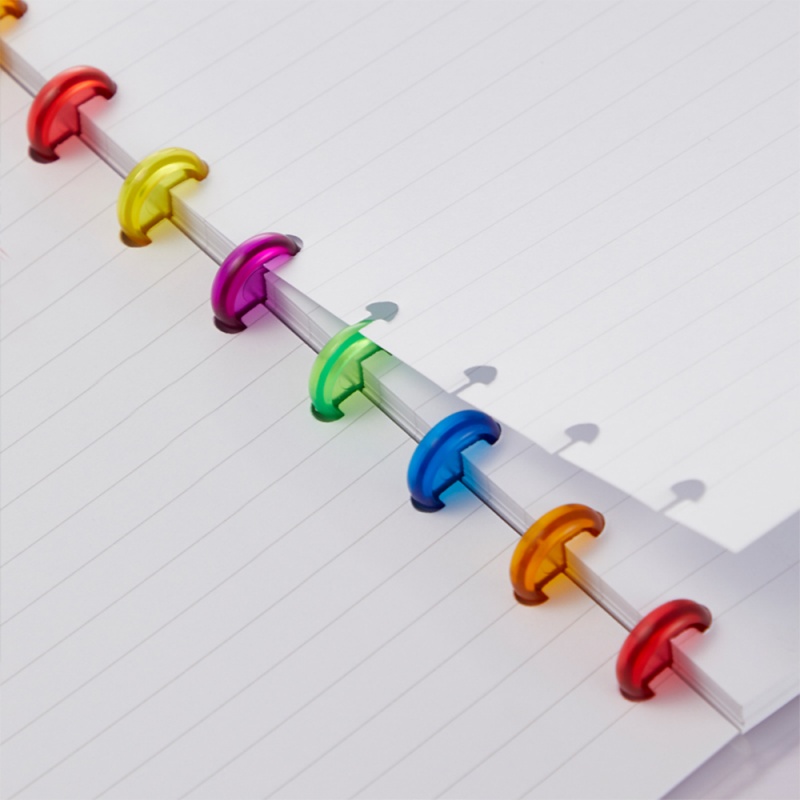
Refillable spiral notebooks are a flexible notebook system that allows pages to be added, removed, or rearranged without damaging the binding. Unlike traditional fixed spiral notebooks, they use an openable binding structure, such as disc systems or ring mechanisms. This gives users full control over page organization and layout.
Key Features
- Uses openable binding systems
- Pages can be added, removed, or rearranged freely
- Compatible with multiple paper types and inserts
- Modular structure supports accessories
- Reusable binding components reduce material waste
Purchasing Considerations
(1) Binding System Compatibility
Disc or ring systems must match the correct page punch design. Misalignment can prevent smooth insertion or cause pages to loosen during use.
(2) Durability of Opening Mechanism
The binding system must withstand repeated opening and closing. Weak rings or discs may lose grip over time, reducing usability.
(3) Accessory Compatibility
Many systems include dividers, tabs, or pockets. Buyers should ensure all components are compatible within the same notebook system.
Classified By Inner Page Type
| Inner Page Format | Features | Applications |
|---|---|---|
| Ruled (Lined) | Horizontal lines provide structured writing guidance. Improves handwriting alignment and readability. | Academic note-taking, office meeting notes, general writing |
| Grid (Square) | Supports precise alignment and structured layout design. Useful for calculations and diagrams. | Engineering notes, mathematics, architecture sketches, data plotting |
| Dot Grid | Offers a flexible structure while maintaining visual guidance. Balances freedom and organization. | Bullet journaling, design sketching, planning layouts, creative writing |
| Blank | Maximum freedom for writing and drawing. Suitable for unrestricted content creation. | Sketching, brainstorming, design drafts, artistic drawing, mind mapping |
Common Sizes of Spiral Notebooks
| Size | Dimensions (mm / inches) | Common Uses |
|---|---|---|
| A4 | 210 × 297 mm (8.3 × 11.7 in) | Standard office documents |
| B5 | 176 × 250 mm (6.9 × 9.8 in) | School notebooks, general writing, compact office use |
| A5 | 148 × 210 mm (5.8 × 8.3 in) | Portable daily notebooks, personal journals, business notes |
| Letter | 216 × 279 mm (8.5 × 11 in) | North American standard size for office documents |
| A6 | 105 × 148 mm (4.1 × 5.8 in) | Pocket journals, quick notes, memo pads |
| Pocket Size | Typically 70 × 100 mm to 90 × 140 mm (varies by manufacturer) | Ultra-portable note-taking, pocket planners |
How to Choose Types of Spiral Notebooks
Step 1: Choose Binding Style Based on Use
(1) Side spiral notebooks
Best for class notes and long-form writing. The side binding lets the pages open like a book, so writing flows naturally across both pages.
(2) Top spiral notebooks
Best for quick notes and mobile writing. The top coil keeps your hand clear while writing. It is also common for journalists and field work.
Step 2: Choose Page Layout Based on Need
(1) Lined pages
Best for text-heavy use such as meetings and essays. College-ruled spacing is more compact and saves space.
(2) Graph paper
Best for math, charts, and technical drawings. It helps keep numbers and shapes aligned.
Dot grid pages
Best for bullet journals and creative layouts. It provides a light structure while keeping the page flexible.
Step 3: Choose Binding Material Based on Usage Intensity
(1) Plastic spiral notebooks
Best for students and daily commuting. The coil is flexible and can recover after pressure in a bag. It is also safer for frequent handling.
(2) Metal spiral notebooks (double wire-o)
Best for office use and formal documents. They are more stable, open flatter, and give a cleaner, more professional look.
Step 4: Choose Fixed or Removable Structure
(1) Removable spiral notebooks
Best for users who need flexibility. Pages can be added, removed, or reordered. Useful for planners and structured study systems.
(2) Fixed spiral notebooks
Best for general writing from start to finish. The structure is more stable and usually lower in cost.

FAQ-Types of Spiral Notebooks
1. How many pages does a typical spiral notebook have?
Standard spiral notebooks usually contain 60 to 120 sheets. However, multi-subject or planner-style notebooks may have higher page counts depending on design and market requirements.
2. What is the advantage of spiral binding compared to glued notebooks?
Spiral binding allows notebooks to lay completely flat and be folded back 360 degrees. It also makes page turning easier and prevents spine damage, offering better usability for frequent writing and long-term use.
3. Is there a difference between spiral-bound notebooks and coil-bound notebooks?
No, they are the same thing. “Spiral” and “coil” are different translations for “Spiral Notebook.”
4. Which is better: single-spiral or double-spiral?
Double-spiral is better. It’s sturdier, less prone to warping, and lays flatter. Single-spiral is commonly found in low-cost notebooks.
5. Can metal coils scratch your hands?
Possibly. If the ends of the coil aren’t properly finished, they might scratch your hands or snag on clothing. High-quality notebooks have smooth, rounded edges.
6. Are plastic coils durable?
They’re durable enough for everyday use, but not as durable as metal. If frequently squeezed in a bag, plastic coils may deform.
7. Can spiral notebooks be recycled?
Yes. It’s recommended to remove the metal or plastic coils for separate recycling and dispose of the paper pages in the paper recycling bin.