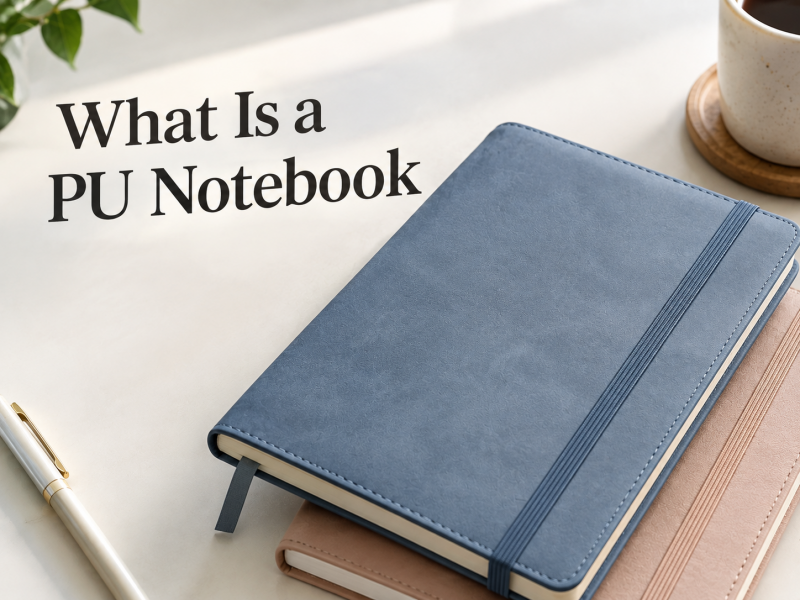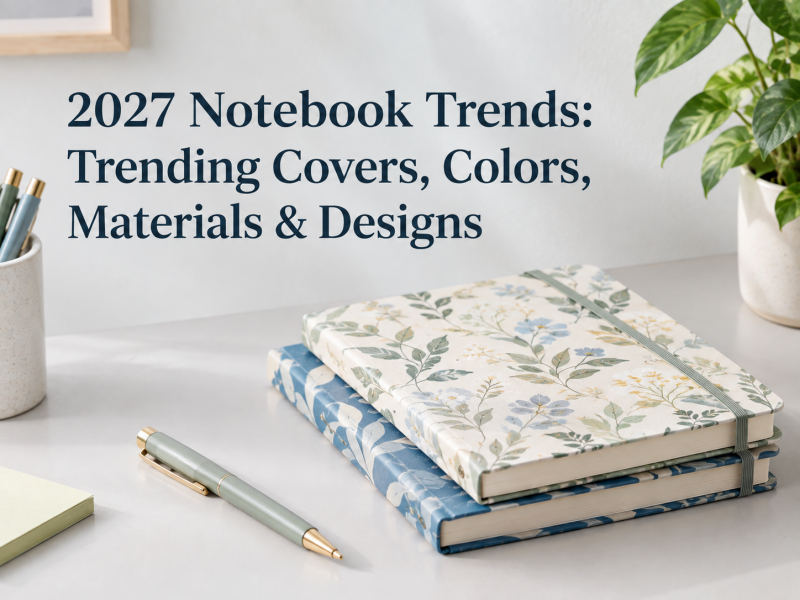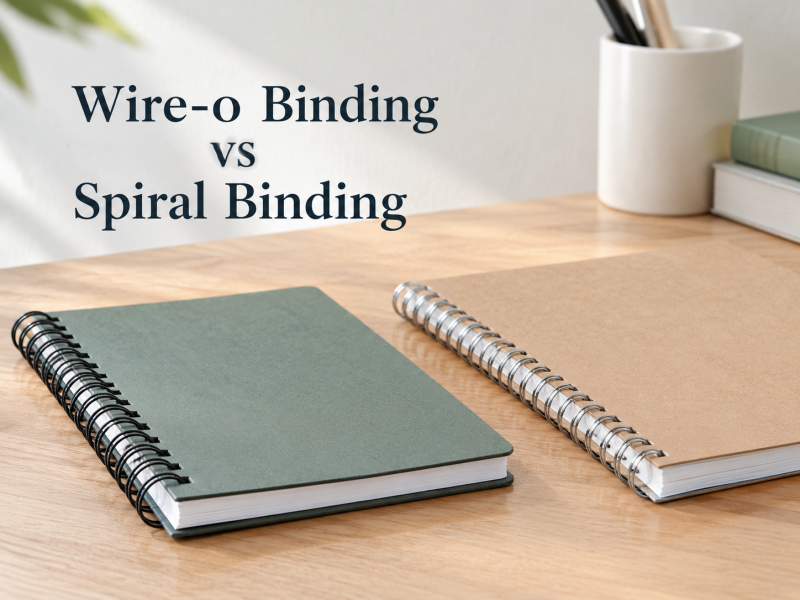
Planners and notebooks are both common stationery products, but they serve different purposes. A planner is designed for schedules, tasks, and time management. A notebook provides a flexible space for writing, notes, ideas, and sketches.
For B2B buyers, the difference goes beyond page layout. The choice can affect product positioning, customization, inventory, and user experience. A planner offers a structured format, while a notebook gives users more freedom in how they use each page.
This difference also affects sourcing decisions. Planners may need specific planning periods, such as daily, weekly, or monthly layouts. Notebooks can be customized with different page formats, paper types, bindings, and covers.
In this guide, we compare planner vs. notebook, explain their common formats and uses, and cover the key specifications buyers should consider when sourcing or customizing these stationery products.

Quick Overview of Basic Concepts
1. Understanding the Planner
A planner is a stationery product designed to help users organize schedules, tasks, and goals. Unlike a notebook, it uses a structured page layout based on time periods or planning tasks.
Key Features of a Planner
- Structured: Pages follow a predefined system, so users can organize information without creating their own layout.
- Time-focused: Content is usually organized around specific dates, weeks, months, or planning periods.
- Task-oriented: Planners often provide dedicated space for tasks, appointments, deadlines, and priorities.
- Goal-driven: Many planners include sections for goals, habits, or progress tracking.
- Easy to review: A consistent layout makes it easier to check past plans and upcoming tasks.
- Less flexible: The fixed structure can limit free-form writing and may leave unused space.
Common Planner Page Formats
Planner pages usually organize time at different levels. Each format serves a different planning purpose:
- Yearly overview: Gives users a view of the whole year. It is mainly used to mark important dates, holidays, major events, and long-term goals.
- Monthly layout: Shows an entire month at a glance. It is useful for planning deadlines, appointments, trips, and other events that need a wider view.
- Weekly layout: Breaks the month into individual weeks. It gives users more space to organize tasks, meetings, and plans for the coming days.
- Daily layout: Focuses on one day. It provides the most space for detailed schedules, time slots, priorities, and daily tasks.
In addition to time-based layouts, planners can include extra sections for specific tasks:
- To-do lists: Help users list and track tasks.
- Goal pages: Provide space for setting and reviewing short- or long-term goals.
- Habit trackers: Help users record recurring habits or activities.
- Notes pages: Provide flexible space for information that does not fit the main planning layout.
Common Uses
- Work: Meetings, deadlines, projects, and task management
- Study: Class schedules, assignments, and exams
- Personal planning: Appointments, events, and daily tasks
- Goal tracking: Habits, personal goals, and long-term plans
The main advantage of a planner is its ready-made structure. Users do not need to create their own calendar or task layout. However, this structure can also be a limitation for users who prefer more freedom or do not follow a fixed schedule.
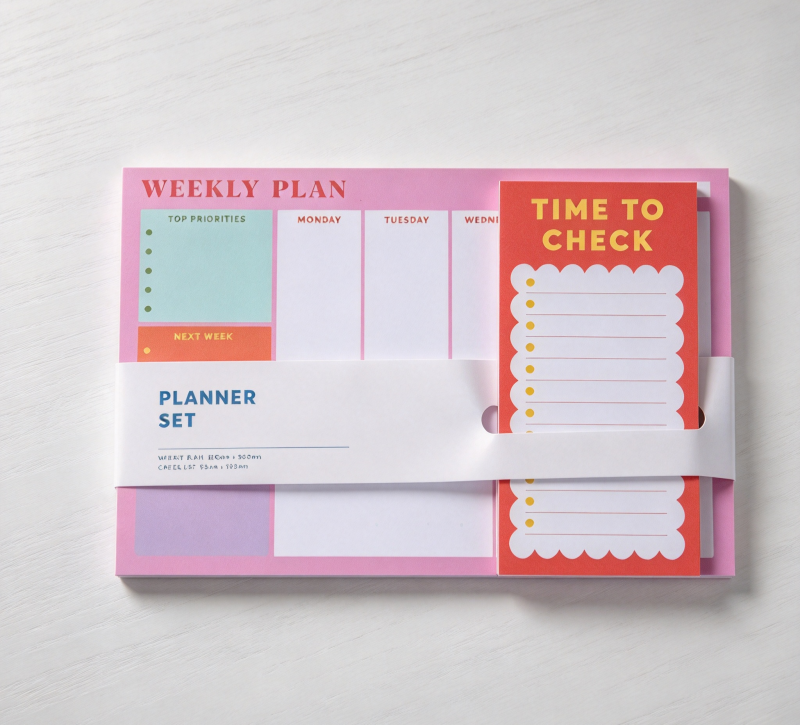
Source: Artcool Weekly Planner Set
2. Understanding the Notebook
A notebook is a stationery product used for writing, note-taking, drawing, and recording ideas. Unlike a planner, it usually has no fixed date-based structure. Users can decide how to use each page and when to start or stop.
Key Features of a Notebook
- Flexible: Users can use the pages for different types of content without following a fixed system.
- Simple structure: The pages provide a basic writing format without telling users how to organize their content.
- Multi-purpose: One notebook can be used for notes, journaling, sketches, ideas, or project work.
- Easy to customize: Different paper layouts, covers, bindings, and accessories can be combined for different markets.
Common Notebook Page Formats
The page format provides basic guidance while leaving the content open:
- Lined pages: Suitable for everyday writing, meeting notes, and journaling.
- Blank pages: Provide maximum freedom for drawing, sketching, and brainstorming.
- Grid pages: Useful for diagrams, calculations, tables, and structured notes.
- Dotted pages: Support bullet journaling, layouts, diagrams, and creative writing while keeping the page visually clean.
Common Uses
Notebooks can be used in many personal and professional settings:
- Work: Meeting notes, project records, and ideas
- Study: Class notes, research, and assignments
- Creative work: Sketches, drafts, and brainstorming
- Journaling: Personal writing and daily records
- Planning: User-created schedules, lists, or bullet journals
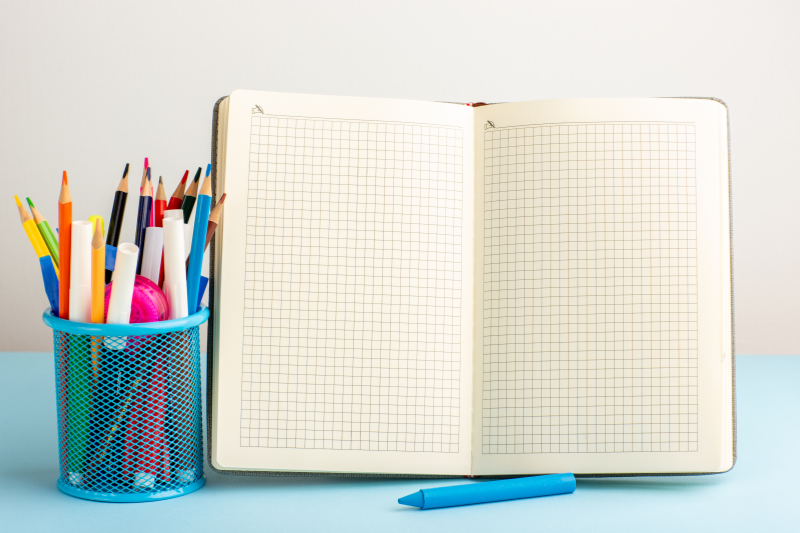
Planner vs. Notebook Comparison
Planners and notebooks may look similar, but they serve different purposes. A planner provides a structured system for managing time and tasks, while a notebook offers flexible space for writing, notes, and creative work.
Planner vs. Notebook at a Glance
| Comparison Factor | Planner | Notebook |
|---|---|---|
| Core purpose | Scheduling, task management, and goal tracking | Writing, note-taking, ideas, and creative work |
| Page structure | Predefined daily, weekly, monthly, or yearly layouts | Lined, blank, grid, or dotted pages |
| Time orientation | Organized around specific dates or planning periods | No fixed calendar structure |
| Flexibility | More structured and guided | More flexible and user-defined |
| Lifespan | Often tied to a specific year or period | Can be used at any time |
| Data retrieval | Easy to find information by date | May require indexes, page numbers, or bookmarks |
| Typical features | Calendars, task lists, tabs, habit trackers, dividers | Bookmarks, pockets, indexes, perforated pages |
| Main material focus | Functional features that support planning | Paper quality and writing performance |
| Typical users | Professionals, students, and users managing schedules | Students, writers, creatives, and general users |
1. Planner vs. Notebook: Structure and Core Purpose
The main difference is how each product organizes information.
A planner starts with a predefined structure. Pages are organized around dates, schedules, tasks, or goals. Users mainly fill in the information provided by the layout.
A notebook starts with a flexible page format. Pages may be lined, blank, dotted, or grid-based. Users decide what to write and how to organize it.
2. Planner vs. Notebook: Timeline and Product Lifespan
Planners are closely connected to calendar time. They may cover a year, month, academic period, or other fixed timeframe. Dated pages are designed for specific periods and may have limited value after that period ends.
Notebooks have no fixed timeline. Users can start them at any time and use them for weeks, months, or years.
This difference also matters for B2B inventory planning. Dated planners often have seasonal demand, while notebooks can generally be sold throughout the year without becoming outdated.
3. Planner vs. Notebook: Flexibility and User Experience
Planners provide more guidance. Their predefined layouts help users organize appointments, tasks, deadlines, and goals without creating their own system.
Notebooks offer more freedom. Users can write several pages in one day, leave pages unused, or use different sections for different purposes.
4. Planner vs. Notebook: Data Retrieval and Organization
Planners make date-based information easy to find. Users can go directly to a specific day, week, or month to review schedules and records.
Notebooks are less structured for retrieval. Without an index or page numbers, finding older notes can take more time.
5. Planner vs. Notebook: Customization and Product Design
Both products offer extensive customization, but the priorities are different. Planners require more attention to the planning structure, while notebooks allow greater freedom in the overall product design.
Planner customization often focuses on the interior system. Buyers may need to define dates, page sequences, calendars, task sections, dividers, tabs, habit trackers, or other planning features.
Notebook customization is usually more flexible. Buyers can select page formats, paper, page count, cover materials, binding, printing, and finishing based on the intended use.
6. Planner vs. Notebook: Functional Features
Planner buyers may focus more on features that improve organization and daily use. These can include monthly tabs, ribbon bookmarks, elastic closures, pockets, dividers, stickers, and pen loops.
Notebook buyers often place greater emphasis on paper quality and writing performance. Key factors include GSM, smoothness, texture, opacity, and ink absorption.
7. Planner vs. Notebook: Target Users
The different functions lead to different target markets.
Planners are commonly used by:
- Professionals
- Project managers
- Students with fixed schedules
- Business users
- Users tracking goals and habits
They are more often positioned around time management, organization, productivity, and goal tracking.
Notebooks are commonly used by:
- Students
- Writers
- Designers and artists
- Professionals
- Journal users
- General note-takers
They are often positioned around writing, creativity, ideas, and flexible everyday use.

How to Choose Between a Planner and a Notebook
The choice between a planner and a notebook depends on the intended use, target users, and product positioning. Use the points below to match the format with your needs.
| You should choose a planner if… | You should choose a notebook if… |
|---|---|
| You need to organize schedules, tasks, or deadlines. | You need flexible space for notes, ideas, or creative work. |
| You prefer dated pages and a clear planning structure. | You prefer undated pages and a flexible format. |
| Daily, weekly, or monthly layouts fit your users’ needs. | Lined, blank, dotted, or grid pages fit your users’ needs. |
| You want users to follow a clear planning system. | You want users to create their own system. |
| Regular task, goal, or habit tracking is important. | Users may write at different times or use the book for different purposes. |
| The product is for professionals, project teams, or users with fixed schedules. | The product is for general users, creatives, students, or business customers. |
| A dated product fits your sales and distribution cycle. | You want a product that can be sold and used year-round. |
| Structured interior pages are more important than layout freedom. | Paper quality, cover design, and flexible customization are more important. |
| The product is mainly an efficiency tool. | The product is mainly a writing tool or brand carrier. |
Key Specifications for Planners and Notebooks
(1) Size
Size determines writing space and portability. Common options include A4, A5, A6, and B5, as well as custom dimensions. Larger sizes provide more space for detailed planning or notes, while smaller formats are easier to carry.
(2) Paper
Paper affects writing performance, printing quality, and product thickness. Key specifications include:
- Paper type
- GSM
- Color
- Texture and smoothness
- Opacity
- Writing performance
(3) Page Count
Page count affects the product’s thickness, weight, binding, and cost. Notebook page counts can be selected more freely, while planner page counts often depend on the planning period and layout. For custom interiors, buyers should provide the required layout or a reference file.
(4) Binding
- Spiral or Wire-O: Easy to turn and can open flat. Suitable for planners and everyday notebooks.
- Thread-sewn: Durable and provides good page flexibility. Suitable for premium notebooks and planners.
- Perfect binding: Clean and cost-effective for suitable page counts.
- Case binding: Provides a durable hardcover structure and a premium appearance.
- Saddle stitching: Lightweight and economical for slim products with fewer pages.
(5) Cover Materials
The cover affects both protection and product positioning.
- PU or vegan leather: Suitable for premium and corporate products. Supports foil stamping and debossing.
- Bookcloth or linen: Creates a refined, fabric-like appearance for premium stationery.
- Coated paper or artboard: Cost-effective and suitable for full-color printing and surface finishes.
- PP: Durable, flexible, and easy to clean. Often used for practical or utility notebooks.
Buyers can also specify cover thickness, printing, texture, lamination, and other finishing requirements.
(6) Printing and Finishing
Custom planners and notebooks can use different printing and finishing methods.
Common options include:
- Offset or digital printing
- Full-color or single-color printing
- Lamination
- Foil stamping
- Embossing or debossing
- Spot UV
- Die cutting
The finish should match the cover material, product design, and target price.
(7) Accessories
Accessories can add functionality or create product differentiation. Common options include:
- Ribbon bookmarks
- Elastic closures
- Pen loops
- Inner pockets
- Dividers
- Stickers
- Perforated pages
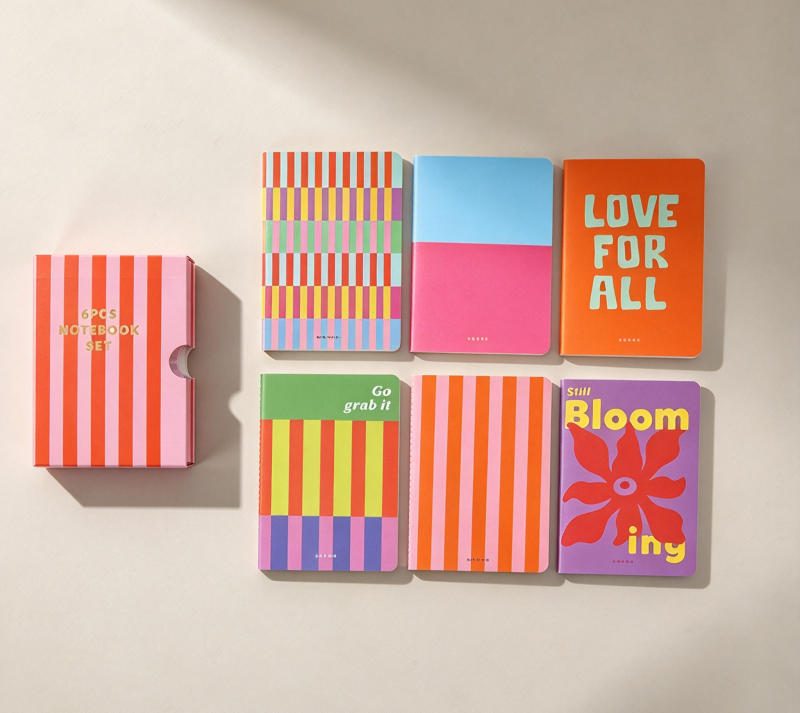
Source: Artcool Notebook Set
Conclusion
Planners and notebooks are not better or worse than each other. They serve different needs. A planner is a structured tool for managing schedules, tasks, and goals. It works well for time management, task tracking, and structured workflows. A notebook is a flexible space for writing, notes, ideas, and creative work. It is more suitable for general use, brand promotion, and long-term storage.
For B2B buyers, the choice should be based on five factors:
- Purpose: Choose a planner for productivity and task management. Choose a notebook for writing and brand exposure.
- Usage: Planners suit teams with fixed schedules. Notebooks work well for general users, creative teams, and corporate gifts.
- Inventory: Dated planners require careful planning and seasonal purchasing. Notebooks can be sold and used year-round.
- Customization: Planners are better suited to structured layouts and planning templates. Notebooks offer more freedom for paper, covers, and branded content.
- Budget and ROI: Consider not only unit cost, but also usage rate, product lifespan, and inventory risk.