Highlighters and markers are often placed in the same stationery category, but they serve very different purposes. Both are used for writing, marking, and visual emphasis, yet their differences go far beyond appearance. Ink type, tip design, and usage scenarios all determine how each tool performs in real applications.
In recent years, the stationery market has expanded the roles of both products. Highlighters are no longer limited to study notes, and markers are no longer just writing tools. As a result, understanding the difference between them has become more important for both consumers and businesses.
This article provides a clear comparison of highlighter vs marker, covering their functions, ink characteristics, design, and common use cases. It is useful for those who want to choose the right product for different needs.
Highlighter vs Marker Market Analysis
Recent market data shows that both highlighter vs marker continue to grow steadily within the global stationery industry. However, their growth drivers and market positioning are different. Although they are often grouped together in retail channels, their target users and usage scenarios are becoming increasingly distinct.
The global highlighter vs marker market was valued at about USD 4,397.5 million in 2024. It is expected to grow at a CAGR of around 1.2% from 2024 to 2033, showing stable but moderate long-term growth.
The global marker pen market was valued at approximately USD 6.35 billion in 2024. It is projected to reach around USD 9.56 billion by 2030, with a CAGR of about 7.1%. Growth is mainly driven by demand from creative industries, logistics, industrial labeling, DIY culture, and professional art use. Permanent markers and alcohol-based art markers account for a large share of the market.
Compared with markers, the highlighter market is smaller in total size but shows stable long-term growth. In 2025, the highlighter market is valued at USD 2.60 billion. By 2033, it is projected to reach USD 4.80 billion, with a CAGR of about 5.8%.
One major difference between the two categories is their growth logic. Marker demand is driven by a wide range of industries and applications. Highlighter growth is more closely linked to lifestyle stationery trends and education-related use.

Understanding Highlighters
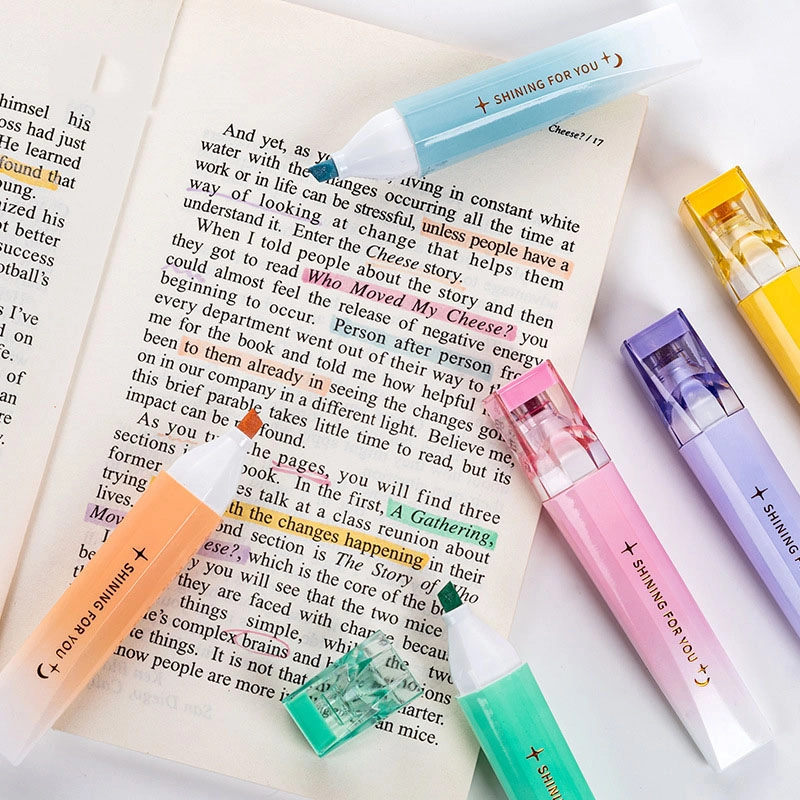
Highlighters are stationery tools designed to make important information stand out without covering the original text. Highlighters use translucent ink that keeps words clearly visible after marking. Their main purpose is to improve readability and help users quickly identify key information.
Most highlighters use water-based fluorescent ink in bright colors. The most common highlighter design uses a chisel tip. Highlighters are usually non-permanent and designed to reduce ink bleed-through on paper.
Key Features of Highlighters
- Translucent Ink: Highlighter ink is designed to emphasize text while keeping the original content readable
- Bright and Attention-Grabbing Colors: Traditional highlighters commonly use fluorescent yellow, pink, orange, green, and blue shades for maximum visibility
- Water-Based Formulas: Most highlighters use water-based ink that produces lower odor and smoother application on paper
- Chisel Tip Design: The chisel tip allows users to create both broad highlighting strokes and narrower underlines
Common Types of Highlighters
- Traditional Fluorescent Highlighters: The most common and widely recognized type. They use bright fluorescent ink
- Gel Highlighters: Use a wax-like gel formula instead of liquid ink. They help reduce smudging and bleed-through, making them suitable for thin paper and books
- Liquid Highlighters: Provide heavier ink flow, brighter color output, and stronger fade resistance. They are often preferred for long-term or high-visibility marking
- Dual-Tip Highlighters: Combine two functions in one pen, usually featuring a chisel tip for highlighting and a fine tip for writing or underlining
- Erasable Highlighters: Use removable ink technology that allows users to erase or adjust highlighted areas more easily
Exploring Markers
Markers are versatile writing and drawing tools designed to create bold, highly visible marks on many different surfaces. Markers are made for writing, labeling, coloring, illustrating, and industrial marking. Their stronger ink coverage and wider range of tip styles make them suitable for both everyday and professional use.
Markers also use different ink formulations for different purposes. Water-based markers are popular in classrooms and offices because they are easier to clean and usually low-odor. Permanent markers are designed for long-lasting marks on surfaces.
Markers are also available in a much wider range of colors and effects. As a result, they are used not only as functional writing tools but also as creative and design-oriented products.
Key Features of Markers
- Opaque Ink: Marker ink is typically more saturated than highlighter ink, allowing bold writing and clear visibility on different surfaces
- Multiple Ink Formulations: Markers are available in water-based, alcohol-based, oil-based, and permanent ink varieties depending on the intended use
- Wide Color Selection: In addition to standard black, blue, and red, markers are commonly produced in metallic, neon, pastel, and artistic color ranges
- Diverse Tip Structures: Marker pens can feature fine tips, bullet tips, brush tips, chisel tips, or dual-tip combinations for different writing and drawing styles
- Multi-Surface Compatibility: Many markers are designed to write on paper, cardboard, plastic, glass, metal, wood, and other packaging or industrial materials
Common Types of Markers
- Permanent Markers: Designed for long-lasting writing on a variety of surfaces. The ink is usually waterproof and smudge-resistant
- Whiteboard Markers: Use dry-erase ink that can be easily wiped from whiteboards and other non-porous surfaces. Commonly used in classrooms, offices, and presentations
- Water-Based Markers: Typically low-odor and easier to clean than permanent markers
- Alcohol-Based Art Markers: Popular among designers and illustrators because they provide smooth color blending and vibrant results. Widely used for sketching, rendering, and professional artwork
- Acrylic Paint Markers: Contain liquid acrylic paint instead of standard ink. They offer strong opacity and work well on surfaces

Highlighter vs Marker: What Are the Main Differences?
Although highlighter vs marker may look similar, they are designed for different purposes. The differences go beyond color and appearance. Ink type, transparency, tip design, and usage scenarios all affect how each product performs.
Understanding these differences helps consumers choose the right tool. For stationery brands, separating the two categories is also important for target market strategy.
| Feature | Highlighter | Marker |
|---|---|---|
| Primary Purpose | Emphasizing existing text | Writing, drawing, labeling |
| Ink Appearance | Translucent | Opaque and bold |
| Common Ink Type | Water-based fluorescent ink | Water-based, alcohol-based, oil-based, or permanent ink |
| Color Style | Mainly bright neon or pastel tones | Extremely wide color range |
| Tip Design | Usually chisel tip | Fine, bullet, brush, chisel, or dual-tip |
| Surface Compatibility | Mostly paper | Paper, plastic, glass, metal, cardboard, and more |
| Permanence | Generally non-permanent | Often permanent or water-resistant |
Frequently Asked Questions About Highlighter vs Marker
1. Can highlighters and markers be used interchangeably?
Not really. A marker may cover text completely, making it hard to read. A highlighter can mark text clearly, but it is usually too light for bold writing or labeling.
2. What is the main difference between a highlighter vs marker?
The biggest difference is ink transparency and intended use. Highlighters are made for emphasizing information, while markers are designed for creating strong, visible writing or artwork.
3. Are all markers permanent?
No. Markers come in several types. Some are erasable, while others are designed for long-term marking.
4. Why do highlighters look fluorescent?
Highlighter ink contains fluorescent dyes that reflect light more intensely than normal ink. This creates the bright “glowing” effect commonly seen in yellow, pink, and green highlighters.
5. Which is more durable: a highlighter or a marker?
Markers are generally more durable because their ink is more opaque and resistant to water, fading, and smudging. Highlighters are mainly designed for temporary paper marking and readability rather than long-term durability.
6. Are highlighter marks visible when photocopied or scanned?
Classic fluorescent yellow highlighters usually create little to no shadow in black-and-white copies or scans. Other colors are more likely to appear as gray marks when copied.
7. Can highlighters be refilled?
Some refillable highlighters allow users to replace or refill the ink. However, most standard disposable highlighters cannot be refilled and must be replaced after the ink runs out.