Desk organizers come in many forms, from multi-compartment pen holders and file racks to drawer dividers and monitor stands with storage. Each types of desk organizers serves a different purpose, helping keep stationery, documents, and office supplies organized and within easy reach.
The right choice depends on what you need to store and how much space you have. Some organizers keep frequently used items on the desktop, while others sort documents, organize drawer contents, or make better use of vertical space.
This guide covers 12 common types of desk organizers, their key features, uses, and materials. Whether you’re choosing products for retail, developing a private-label stationery collection, or sourcing corporate gifts, you’ll find practical tips to help you select the right options.

Benefits of Using Desk Organizers
Desk organizers do more than keep supplies in place. They help users find items faster, make better use of desk space, and maintain a more organized workspace. These benefits also make desk organizers useful products for office, school, retail, and corporate gift markets.
1. Reduce Clutter and Support Focus
Loose papers and scattered stationery can make a desk feel crowded. Desk organizers give everyday items a fixed place, helping users keep their work area clear.
Research published by Harvard Business Review found that participants working beside a messy desk took nearly 10% longer to complete a color-and-word matching task than those beside a neat desk. They also reported feeling more frustrated and tired.
A 2024 study reported by Yale University found that visual clutter can affect how efficiently the brain processes visual information. Although the study did not focus on desk organization, it offers insight into how clutter can affect visual processing.
Desk organizers help group supplies and reduce visual clutter. This can make a workspace easier to manage and more comfortable to use.
Sources:
- Harvard Business Review: A Messy Environment Makes It Harder for You to Focus on a Task
- Yale University: Visual Clutter Alters Information Flow in the Brain
2. Find Supplies More Quickly
Searching for misplaced items interrupts work. Pen holders, file racks, desk trays, and drawer organizers give supplies a consistent place, so users can find what they need more easily. Desk organizers address this problem at the workspace level. Keeping pens, notes, files, and small accessories in designated places makes everyday tasks easier to manage.
3. Make Better Use of Desk Space
Desk organizers help users make better use of available space. Stackable trays and vertical file holders reduce the need to spread papers across the desktop. Monitor stands add storage underneath, while wall-mounted organizers free up desk space. These designs are especially useful when the work surface is limited.
4. Offer Flexible Styles for Different Markets
Desk organizers come in various materials, colors, and designs. Metal and wood styles suit professional workspaces, while colorful plastic and printed paperboard options can appeal to students and retail customers.
For wholesalers and brand owners, custom colors, logos, and packaging also make desk organizers suitable for private-label collections and corporate gifts.

12 Popular Options Types of Desk Organizers
1. Desktop Organizers
Desktop organizers combine several storage compartments in one unit. They keep frequently used supplies, such as pens, sticky notes, paper clips, scissors, and notepads, within easy reach.
Designs range from simple multi-compartment holders to larger units with drawers, note slots, and card holders. Compact models suit student desks and small workspaces, while larger organizers provide more storage for busy offices.
When choosing a desktop organizer, consider the types of items you need to store, the size of each compartment, and the space available on your desk. A well-designed layout makes supplies easier to find without overcrowding the work surface.

2. Pen and Pencil Holders
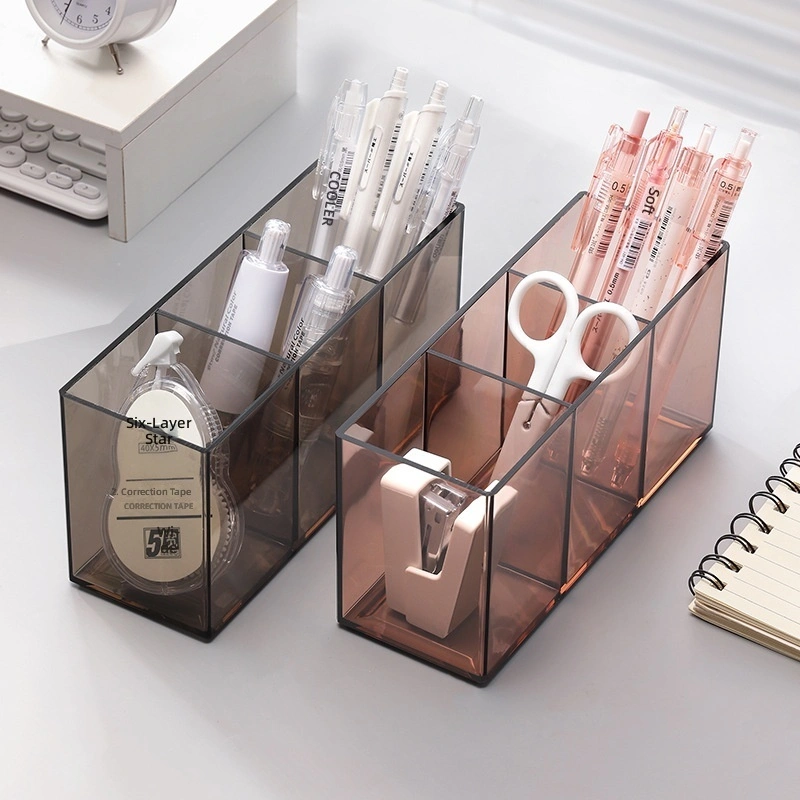
Pen and pencil holders keep writing tools organized and within easy reach. They are common desk accessories for offices, schools, and home workspaces.
Basic designs have a single compartment for pens and pencils. Multi-compartment holders separate pens, markers, highlighters, and scissors. Some also include small sections for paper clips and sticky tabs. Rotating models provide easy access to supplies from different sides.
When choosing a holder, consider its capacity, opening width, and depth. A wide opening makes it easier to see and select pens, while a holder that is too deep can make shorter items difficult to reach. A stable base also helps prevent taller holders from tipping over.

Source: Artcool Sweet Dream Gift & Stationery
3. Desk Trays
Desk trays keep loose papers, letters, invoices, and documents organized. They help users separate incoming paperwork, pending tasks, and completed work. They are common in offices, reception areas, and home workspaces.
Common designs include single-layer trays, stackable trays, and tiered letter trays. Single trays suit light use, while multi-layer designs provide separate spaces for different documents. Some models include label slots for easier identification.
When choosing a desk tray, consider the paper size, tray capacity, and available desk space. Make sure it can hold standard A4 or Letter-size documents for your target market. Also, check whether stackable models can be connected securely and whether extra parts are needed. Front-opening trays are convenient for desks where users access documents from the front, while side-opening designs may suit different desk layouts.

4. File and Document Organizers
File and document organizers keep folders, reports, notebooks, and loose papers sorted and easy to access. Unlike flat desk trays, many designs store documents upright or in separate pockets. This makes it easier to find specific files without moving other items.
Common types include vertical file holders, magazine files, expanding file folders, and multi-compartment document sorters. Vertical holders keep folders and notebooks upright, while expanding organizers use labeled pockets to sort documents by project, date, or category. Some models also feature label slots for quick identification.
When choosing a file organizer, consider the document sizes, storage capacity, and available desk space. Check that the compartments fit your folders and notebooks. For vertical designs, a stable base helps prevent tipping when users remove files. If desk space is limited, a compact file holder can keep documents accessible without taking up too much room.

Source: Artcool Shell Poem Gift & Stationery
5. Desk Drawer Organizers
Desk drawer organizers keep small office supplies sorted inside drawers. They help store items such as paper clips, sticky notes, pens, USB drives, and charging cables. This keeps the desktop clear and makes small items easier to find.
Common designs include fixed-compartment trays, adjustable dividers, and modular storage bins. Fixed compartments suit drawers with regular storage needs, while adjustable dividers and separate bins offer more flexibility. Some designs also feature non-slip bases to prevent movement when the drawer opens and closes.
Before choosing an organizer, measure the drawer’s internal length, width, and height. Check the available space around the drawer slides and other fittings. The organizer should fit securely without blocking the drawer from closing. Also, consider the size and weight of the items you plan to store.

6. Monitor Stands with Storage
Monitor stands with storage raise a computer monitor and create extra space for office supplies. They can also help improve screen height and reduce the need to keep items directly on the desktop.
Common designs include stands with open shelves, built-in drawers, and side compartments. The space underneath can hold a keyboard, notebook, or other small items. Some models also include slots for phones, tablets, or pens.
When choosing a monitor stand, check its weight capacity, platform size, and height. Make sure it can support the intended monitor and provides enough clearance underneath for a keyboard. For models with drawers, consider their size, capacity, and ease of use. Compact designs suit small desks, while stands with larger storage areas work well for busy workspaces.

7. Desktop Drawer Units
Desktop drawer units provide enclosed storage for stationery, documents, and small office supplies. Unlike open organizers, they keep items out of sight and help reduce visual clutter. They are useful for storing sticky notes, paper clips, cables, and other accessories.
Common designs include compact single-drawer units, multi-tier drawer cabinets, and models with drawers of different sizes. Small drawers suit stationery and other small items, while larger drawers can hold notebooks, loose papers, and files. Some units have clear drawers that make contents easy to identify. Others feature solid drawers for a neater appearance.
When choosing a desktop drawer unit, consider its overall size, drawer depth, and storage capacity. Check that the drawers open smoothly and that the unit remains stable when they are pulled out. Compact vertical models suit small desks, while wider units offer more storage. For taller designs, a stable base is important to help prevent tipping.

8. Cable Organizers
Cable organizers keep charging cables, power cords, and computer wires neat and easy to manage. They help prevent tangles and reduce clutter around monitors, laptops, and other desk equipment.
Common types include cable clips, cable ties, cable sleeves, cable management boxes, and under-desk trays. Clips hold individual cables in place, while ties and sleeves bundle several wires together. Cable boxes conceal power strips and adapters, while under-desk trays keep excess cables off the floor and out of sight.
When choosing a cable organizer, consider the number and thickness of your cables, how often you need to access them, and where they run. Check that adhesive clips can hold cables securely and that under-desk models fit your desk and installation needs. Cable boxes should have suitable openings for cables and enough ventilation for power strips and adapters.

9. Wall-Mounted Organizers
Wall-mounted organizers use vertical space to store documents, stationery, and small accessories. They keep frequently used items within reach while freeing up valuable desk space. They are especially useful in small home offices, student workspaces, and cubicle offices where desktop space is limited.
Common types include wall file pockets, pegboards, wall grids, and floating shelves. Wall file pockets keep letters, folders, and project documents sorted. Pegboards and grid panels use hooks, baskets, and small shelves to hold different supplies. Floating shelves provide extra space for notebooks, books, and other office essentials.
When choosing a wall-mounted organizer, consider its size, load capacity, and installation method. Screw-mounted designs offer secure support but require drilling. Magnetic or partition-mounted models suit compatible office cubicles, while adhesive options may work for lighter items. Always check the mounting requirements and weight limits before installation.

10. Rotating Desk Organizers
Rotating desk organizers feature a spinning base that lets users access supplies from different sides without moving the entire unit. They keep frequently used items, such as pens, markers, scissors, and paper clips, within easy reach.
Common designs include single-layer rotating trays, multi-compartment pen holders, and multi-tier rotating organizers. Some models also feature small drawers or a mix of deep compartments for writing tools and shallow sections for smaller accessories. Compact designs suit individual desks, while multi-tier models provide more storage without taking up much extra surface space.
When choosing a rotating organizer, check the base stability and how smoothly it turns. The compartments should fit the items you plan to store, and the unit needs enough space to rotate freely. For multi-tier designs, a stable base is especially important when the organizer is fully loaded.

11. Portable Desk Caddies
Portable desk caddies keep office supplies together in one container that users can carry between work areas. They are useful for teachers, students, remote workers, and employees who use shared desks or move between workspaces.
Most designs feature a built-in handle and several compartments for pens, markers, scissors, sticky notes, notebooks, and other supplies. Some have removable dividers or larger sections for bulkier items. Foldable models can also be stored flat when not in use.
When choosing a portable caddy, consider its weight, handle strength, compartment layout, and capacity. The handle should remain secure when the caddy is fully loaded, and the base should be stable enough to prevent items from tipping over. For frequent use, choose a design that is easy to carry and clean.

12. Modular Desk Organizers
Modular desk organizers consist of separate storage units that users can arrange, combine, or expand to suit their needs. Unlike fixed organizers, they allow users to adjust the layout as their workspace or storage needs change.
Common components include pen holders, trays, small drawers, document holders, and storage boxes. Some systems use interlocking parts or magnetic connections to keep modules in place. Others feature independent pieces that can be arranged side by side or stacked.
When choosing a modular organizer, check how securely the components fit together and whether additional units are available. Consider the size of each module and the space needed for the complete setup. Independent pieces offer more freedom in placement, while connected systems provide greater stability when moved.

Common Materials Used in Desk Organizers
Desk organizers come in different materials, each with its own balance of durability, appearance, weight, and cost. The best choice depends on the intended use, target market, and product design.
1. Plastic
Plastic organizers are lightweight, affordable, and easy to clean. They come in many colors and shapes, from simple pen holders to multi-compartment storage units. They suit everyday office use, student desks, and large-volume retail orders.

2. Metal
Metal organizers are sturdy and offer a clean, professional look. Wire mesh is common in pen holders, paper trays, and file racks. Solid metal designs provide a more streamlined appearance. When sourcing metal organizers, check the coating quality, edge finish, and resistance to rust.

3. Wood and Bamboo
Wood and bamboo organizers add a natural look to desks. They are popular for home offices, premium stationery collections, and corporate gifts. MDF with a wood-grain finish can offer a lower-cost alternative to solid wood. However, wood-based products need protection from moisture and may cost more than basic plastic models.

4. Acrylic
Acrylic organizers feature a clear, smooth finish that makes stored items easy to see. They suit modern workspaces and display-oriented storage, including pen holders and small accessory trays. However, acrylic can scratch or crack if handled roughly, so packaging and surface protection are important.
5. Fabric and Felt
Fabric and felt organizers are lightweight and often provide a soft, quiet storage option. They are commonly used for portable caddies, drawer inserts, and storage bins. Some designs include reinforced panels to maintain their shape. These materials work well for lightweight supplies but may be harder to clean than plastic or metal.

Source: Artcool Meow Woof Mania Gift & Stationery
6. Paperboard and Cardboard
Paperboard and cardboard organizers offer lightweight, cost-effective storage for stationery and small office supplies. Their surfaces can be printed with custom colors, patterns, and logos, making them suitable for promotional products and branded stationery collections. Durability depends on the board grade, construction, and surface finish. These materials are less suitable for heavy loads or damp environments.

Source: Artcool Sardine Dash Gift & Stationery
FAQ
1. What is the most common types of desk organizers?
Desktop organizers with multiple compartments are among the most common types of desk organizers. They hold everyday supplies such as pens, sticky notes, scissors, and paper clips in one place. Pen holders and desk trays are also widely used for specific storage needs.
2. What is the difference between a desk organizer and a drawer organizer?
A desk organizer sits on the desktop and keeps frequently used items within easy reach. A drawer organizer fits inside an existing drawer and separates small items into compartments. The main difference is where they are used and how they store supplies.
3. Which desk organizers are best for small spaces?
Wall-mounted organizers, vertical file holders, monitor stands with storage, and compact desktop drawer units are useful for small workspaces. They make better use of wall space, vertical space, or areas beneath the monitor. Portable caddies are another option for shared desks where supplies need to be moved between work areas.
4. What material is best for desk organizers?
The best material depends on the intended use and budget. Plastic is lightweight, affordable, and easy to clean. Metal offers good strength, while wood and bamboo provide a natural appearance. Acrylic suits transparent designs.
5. How can I keep a desk organizer from becoming cluttered?
Choose an organizer that fits the supplies you use regularly. Give each compartment a clear purpose and remove items you no longer need. Avoid buying a unit that is larger than necessary, as extra compartments can encourage unnecessary storage.
6. Can desk organizers be customized for a brand?
Yes. Depending on the product and material, customization options may include colors, dimensions, compartment layouts, logos, printed designs, and packaging. Before placing an order, confirm the available options, minimum order quantity (MOQ), sample approval process, and production lead time with your supplier.
7. What should I check before buying desk organizers in bulk?
Check the dimensions, material quality, stability, compartment design, and finish. Make sure the product suits its intended use and target market. For customized orders, request samples and confirm the specifications, packaging, MOQ, and delivery schedule before production.

Conclusion
Desk organizers serve different storage needs, from keeping everyday supplies within reach to sorting documents, hiding clutter, and making better use of limited space. The right product mix depends on your target customers, workspace needs, and budget.
For brands and retailers, offering a range types of desk organizers can help build stronger product collections. Desktop organizers suit daily use, while file holders, drawer organizers, and wall-mounted designs address specific storage needs. Portable and modular options offer more flexibility for changing workspaces.
Rather than chasing novelty, focus on practical design, product quality, and the needs of your target market. If you are sourcing desk organizers in bulk, consider custom sizes, private-label printing, and product bundles to match your business goals.
Contact our team to discuss your requirements, request samples, or develop custom desk organizers for your market.